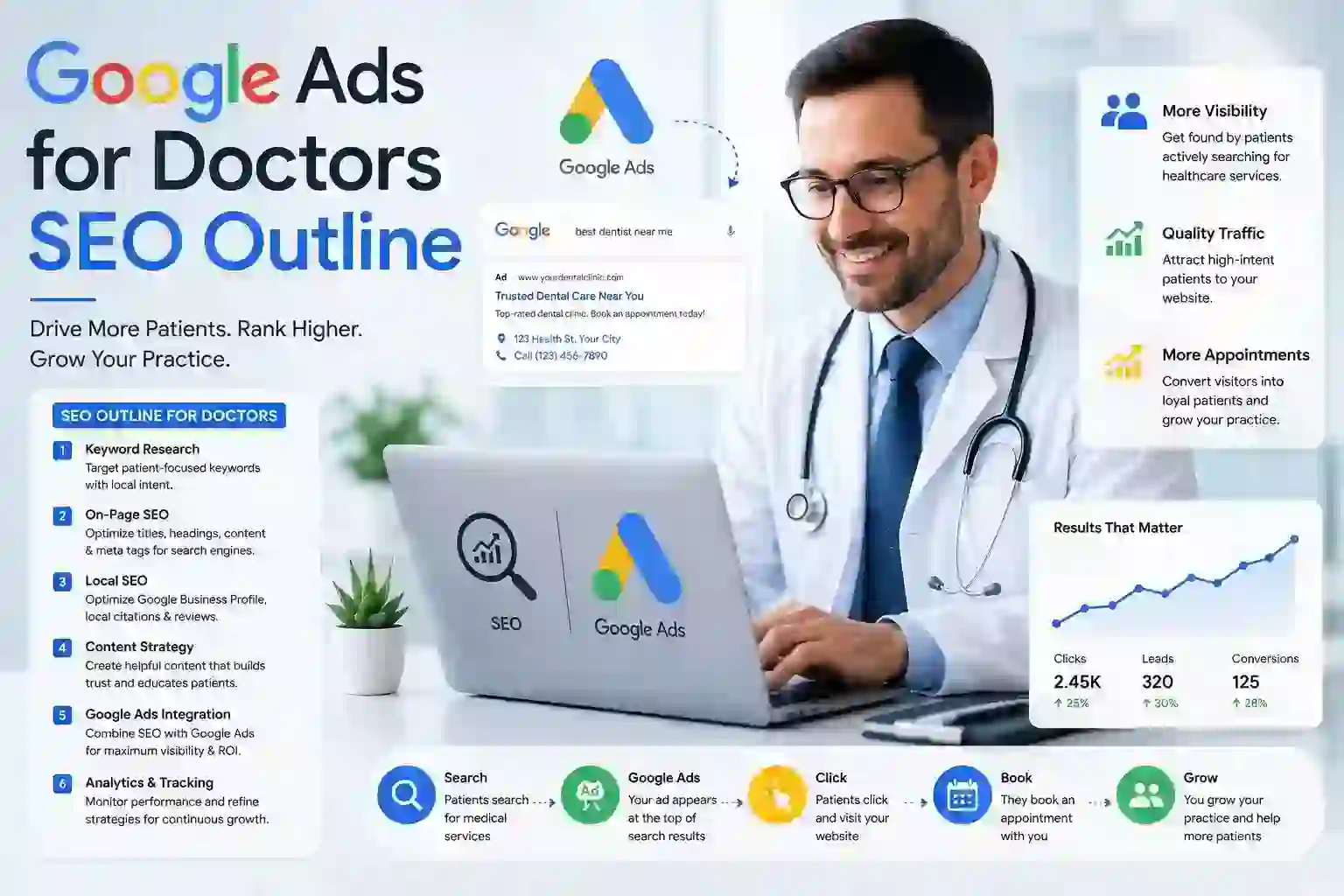
Google Ads For Doctors SEO Outline: The Complete Patient Growth Blueprint
By a Healthcare Digital Marketing Strategist | Reviewed for accuracy against current Google Ads healthcare advertising policy | Last updated 2026
Most doctors pour money into Google Ads and watch it disappear with barely a phone call to show for it. The ads get disapproved, the landing page has no trust signals, and the SEO behind it is nonexistent. This google ads for doctors seo outline fixes that. It combines a compliant ad structure with a search-ready website, so every dollar spent on clicks is backed by content that keeps ranking long after the ad budget runs out.
What Is an SEO Outline for Google Ads for Physicians?
A google ads for doctors seo outline is a documented plan that connects paid search campaigns with organic SEO so both channels support the same patient journey instead of competing for the same clicks. It maps out keyword groups, ad compliance rules, landing page structure, and content pillars in one place.
Doctors who treat Google Ads and SEO as separate projects usually pay twice for the same visibility. A shared outline prevents that. It also gives a practice manager or marketing agency a single reference document to check campaigns against Google’s healthcare policies before anything goes live.
Why Doctors Need Both Google Ads And SEO Together
Paid search brings patients in this week. SEO builds the reputation that convinces those patients to book. Neither works fully alone.
- Google Ads gets a new clinic in front of searchers immediately, but the cost per click in medical categories is high and traffic stops the moment the budget stops.
- SEO takes months to build, but once a practice ranks organically for conditions and treatments it serves, that traffic keeps arriving for free.
- Search engines also read signals across both channels. A site with strong organic content and clear author credentials tends to get lower disapproval rates and better Quality Scores on its ads.
Running both channels from one google ads for doctors seo outline means the keyword research, the messaging, and the compliance checks only need to be done once.
Understanding Google’s Healthcare Advertising Policies Before You Launch
Healthcare sits inside Google’s most tightly regulated ad category, and the rules shift often enough that a plan built a year ago can already be outdated.
Current requirements worth building into any medical Google Ads campaign include:
- Prescription drug promotion, online pharmacy services, and addiction treatment ads generally require separate certification, and third-party accreditation is typically expected for pharmacies, addiction treatment centers, and telehealth providers in major markets like the US, Canada, and the UK.
- A practice cannot build audiences around particular diagnoses or medical histories because Google prohibits tailored ad targeting based on a person’s health issues; keyword-based search campaigns are the safer option, more compliant route for most clinics.
- Advertisers running health or medical insurance coverage ads in the United States generally need certification first, though dental, vision, and travel health coverage ads are usually exempt from this requirement.
- Health claims used in ad copy or on landing pages need to be backed by credible evidence rather than guaranteed outcomes, and clinical trial promotions should link to a verified registry listing.
Building compliance checks into the outline from day one avoids the disapproval cycle that wastes weeks of ad spend.
Step 1: Keyword Research For Medical Practices
Keyword research for a clinic is different from e-commerce keyword research because search intent splits into three clear groups.
- Symptom and condition searches — “why does my knee hurt when I walk,” “signs of high blood pressure.” These searchers want information first.
- Treatment and service searches — “physical therapy for sports injury,” “same day dental filling.” These searchers are closer to booking.
- Local and branded searches — “pediatrician near me,” “[Clinic Name] reviews.” These convert the fastest and should be prioritized in both ads and on-page SEO.
A doctor’s google ads for doctors seo outline should assign each keyword group to the right channel: informational searches feed blog content and topic clusters, while service and local searches feed Google Ads campaigns and dedicated service pages.
Step 2: Structuring A Google Ads Campaign For A Medical Practice
A clean campaign structure keeps Quality Scores high and makes disapprovals easier to trace and fix.
| Campaign Element | Recommended Setup |
| Campaign type | Search, split by service line (e.g., Dermatology, Orthopedics) |
| Ad groups | One per specific procedure or condition, tightly themed |
| Match types | Phrase and exact match to control spend and relevance |
| Location targeting | City and surrounding radius, not broad national targeting |
| Ad extensions | Call, location, sitelinks, and structured snippets for services |
| Landing page | A dedicated page per ad group, never the homepage |
| Negative keywords | “free,” “jobs,” “salary,” “DIY,” symptom-only searches with no service intent |
This structure keeps every ad group tightly matched to one landing page, which improves both Quality Score and conversion rate.
Step 3: Writing Ad Copy That Follows Google’s Health Rules
Ad copy for medical practices needs to be persuasive without making promises Google — or a regulator — won’t allow.
- Lead with a real differentiator: same-day appointments, board-certified staff, insurance accepted, years in practice.
- Avoid absolute claims like “guaranteed results” or “pain-free forever.” Google and most medical boards treat these as red flags.
- Add an obvious call to action, like “Book Your Consultation” or “Check Available Times.”
- Use ad extensions to show address, phone number, and specific services, since these build trust before the click even happens.
Step 4: Landing Page SEO For Doctors — The E-E-A-T Checklist
Google’s Helpful Content guidance rewards pages that show real experience and expertise, and this matters even more in medical topics because Google classifies health content as Your Money or Your Life content.
A compliant, high-converting landing page should include:
- A named, credentialed physician or provider attached to the page content.
- A short bio showing where the provider trained and how long they have practiced.
- Original photos of the clinic, staff, or equipment rather than stock imagery.
- Clear contact details, business hours, and accepted insurance.
- Patient testimonials that comply with privacy rules and do not reveal protected health information.
- A short FAQ answering the exact questions patients ask before booking.
Pages built this way tend to earn both better ad Quality Scores and better organic rankings, because they satisfy the same trust signals Google checks for in both systems.
Step 5: Local SEO And Google Business Profile Optimization
Most medical searches carry local intent, so a Google Business Profile often outperforms the website itself in the map pack.
- Fill in every service category accurately rather than choosing one generic label.
- Add real photos monthly and respond to every review, positive or negative.
- Keep the practice name, address, and phone number identical across the website, directories, and the Business Profile.
- Answer frequently asked questions by patients in the Q&A area before they even visit the website.
A strong Business Profile also lowers cost per click over time, since branded and local searches convert at a much lower cost than broad keyword traffic.
Step 6: Content Marketing And Topical Authority For Medical Websites
Ranking a clinic website long-term means building topical authority, not just optimizing one page.
- Create a pillar page for each major service line, then link out to supporting articles on related conditions, treatments, and recovery timelines.
- Answer real patient questions in plain language, since Google increasingly favors content that reads clearly even to someone without medical training.
- Update older articles regularly rather than only publishing new ones, since freshness signals matter for health content.
- Reference credible external sources such as peer-reviewed studies, professional medical associations, or government health agencies to reinforce trustworthiness.
Budgeting: How Much Should Doctors Spend On Google Ads?
Medical keywords are some of the most expensive in Google Ads because competition and patient lifetime value are both high. A realistic starting budget depends on specialty and location, but most single-location practices see workable results starting between $1,500 and $4,000 per month in ad spend, with cosmetic and dental procedures often costing more per click than primary care.
Rather than fixing a number first, calculate it backward:
- Estimate the value of one new patient over their relationship with the practice.
- Decide what percentage of that value is worth paying to acquire them.
- Divide by the average cost per click in that specialty to estimate how many clicks the budget can sustain.
Common Mistakes Doctors Make With Google Ads
- Sending every ad to the homepage instead of a matching service page.
- Ignoring healthcare certification requirements and getting the whole account flagged.
- Targeting broad match keywords with no negative keyword list, which drains budget on irrelevant clicks.
- Never connecting the ad account to a call tracking or booking system, making it impossible to measure real return on spend.
- Publishing thin, generic service pages with no author credentials, which hurts both Quality Score and organic rankings.
Measuring Success: KPIs Every Medical Practice Should Track
- Cost per booked appointment — not just cost per click, since clicks alone don’t fill a schedule.
- Call tracking numbers — most patients still call a clinic instead of filling out a form.
- Landing page conversion rate — the percentage of visitors who actually request an appointment.
- Organic keyword rankings — tracked monthly for the same service and condition terms used in ads.
- New patient source — tagging every new patient by channel to see which one is actually filling the schedule.
The Complete Google Ads For Doctors SEO Outline (Quick Reference)
| Phase | Action | Owner |
| 1. Research | Group keywords by intent: symptom, service, local | Marketing lead |
| 2. Compliance | Apply for any required Google healthcare certification | Practice admin |
| 3. Campaign build | Structure ad groups by service line with tight match types | PPC manager |
| 4. Landing pages | Build one E-E-A-T-compliant page per ad group | Web team |
| 5. Local SEO | Optimize and maintain the Google Business Profile | Front desk / marketing |
| 6. Content | Publish supporting articles under each service pillar | Content team |
| 7. Tracking | Connect call tracking and booking data to ad performance | PPC manager |
| 8. Review | Audit disapprovals, spend, and rankings monthly | Practice owner |
Frequently Asked Questions
Is Google Ads worth it for a small medical practice?
Yes, for most local practices it is worth testing. A small, well-targeted local campaign focused on high-intent service keywords can bring in new patients faster than SEO alone, especially for a newly opened clinic that has no organic rankings yet.
Do doctors need special certification to run Google Ads?
It depends on the service. General practice and most specialty clinics do not need certification, but prescription drug services, online pharmacies, addiction treatment, and health insurance advertising all require Google-specific certification before ads can run.
How long does SEO take to work for a doctor’s website?
Most medical practices start seeing measurable organic movement within four to six months, with stronger results building over a year as content and local citations accumulate. This is why running Google Ads alongside SEO matters — it covers the gap while organic rankings build.
What keywords should a doctor avoid in Google Ads?
Avoid broad, unqualified terms like “medicine” or “treatment” without a specific condition or service attached, since these waste budget on irrelevant clicks. Also avoid restricted drug terms and any absolute outcome claims that could trigger a policy disapproval.
Can a clinic target patients based on their medical condition?
No. Google’s advertising policy blocks targeting or personalization based on a person’s inferred health conditions. Campaigns should be built around keyword intent instead, since that keeps targeting compliant while still reaching the right searchers.
What is the fastest way to improve Quality Score for medical ads?
Match each ad group tightly to one landing page that reflects the exact keyword and service being advertised. A dedicated, relevant landing page consistently improves Quality Score more than any bid adjustment.
Final Thoughts
A google ads for doctors seo outline only works when paid and organic search are built from the same plan instead of two separate projects. Start with compliant campaign structure, back it with landing pages that show real credentials and experience, and support both with content that keeps ranking after the ad budget runs out. Review the outline monthly, track cost per booked appointment rather than cost per click, and adjust based on which keywords actually fill the schedule. Practices that follow this structure consistently see lower acquisition costs and steadier new patient growth than those running ads and SEO as separate, disconnected efforts.
Sources referenced:
- Google Ads Help — Healthcare and Medicines Advertising Policy
- Google Ads Help — Health Insurance Advertiser Certification
- AuditSocials — Google Ads Policy 2026 Complete Reference