What Are Brand Name Normalization Rules? A Complete Standardization Guide
By the Data & Content Standards Desk | Accurately reviewed | Updated 2026
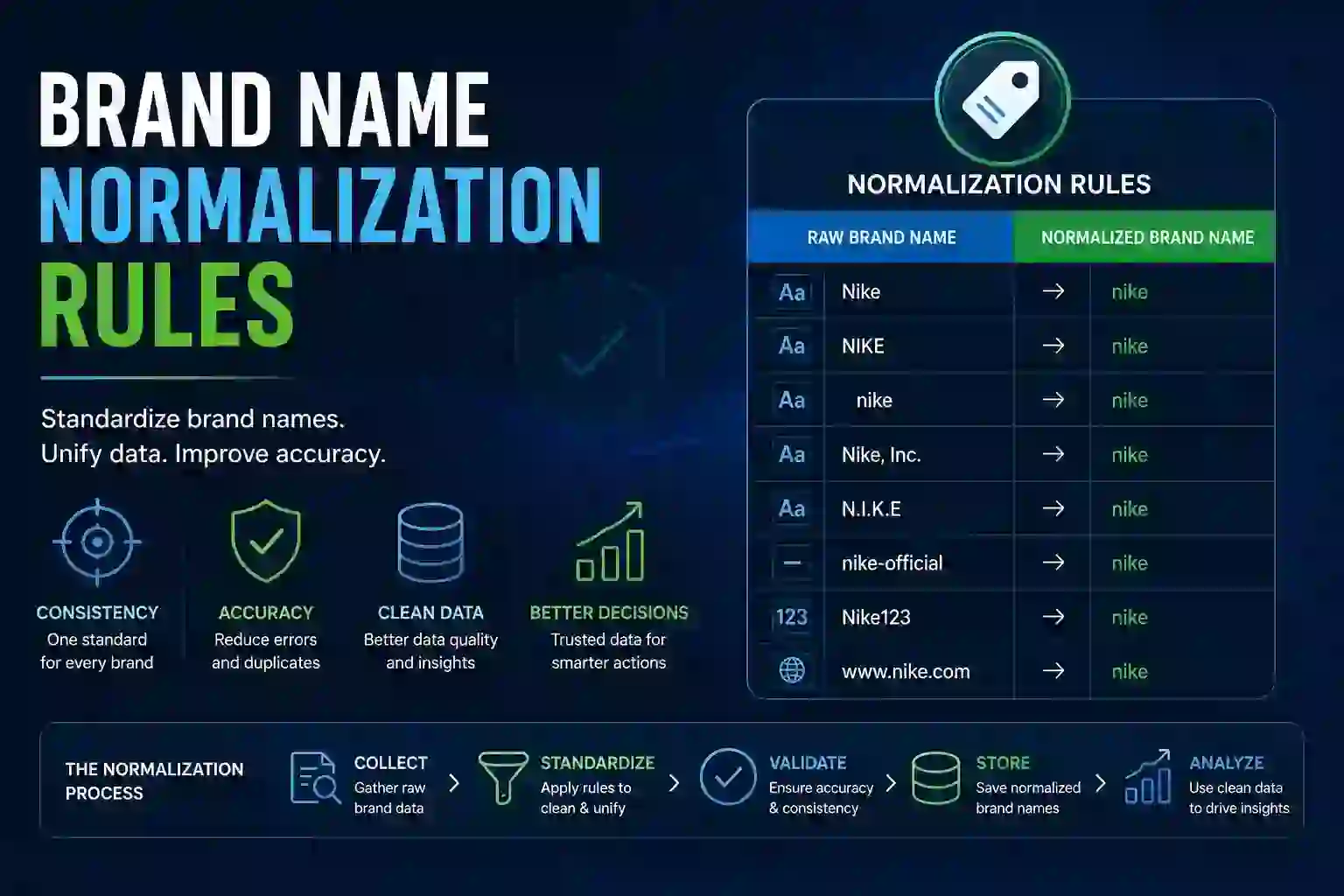
Your database probably lists the same company five different ways right now. “Nike,” “NIKE,” “Nike Inc.,” and “nike, inc.” might all sit in separate rows, quietly splitting one brand into four fake ones. That’s the problem brand name normalization rules exist to fix, and it costs marketing teams real money every quarter. This guide breaks down the exact rules, order of operations, and tools that turn scattered brand entries into one clean, trustworthy source of truth.
What Are Brand Name Normalization Rules?
Brand name normalization rules are a set of ordered instructions that convert every spelling, spacing, or formatting variant of a company or product name into one approved version, known as the canonical name. Instead of “Coca-Cola,” “Coca Cola Co,” and “coke” living as three separate entries, normalization rules merge them into a single record your systems can trust.
These rules typically run inside a data pipeline, a CRM, or a content management workflow. Every time a new brand name enters your system — through a form, an import, or an API — the rules check it against a master list and rewrite it into the canonical format automatically.
Without brand name normalization rules, the same company can silently exist as ten different records. With them, that company exists as one.
Why Brand Name Normalization Rules Matter
Messy brand names don’t just look sloppy. They actively break the systems that rely on them.
- Broken reporting: Revenue or traffic tied to “Amazon” and “Amazon.com Inc.” gets split into two lines instead of one, understating both.
- Duplicate outreach: Sales teams contact the same account twice because the CRM sees two different brand names.
- Weak SEO entity signals: Search engines match brand mentions to a Knowledge Graph entity. Inconsistent naming across your site and structured data weakens that match.
- Failed product matching: E-commerce catalogs that mix “adidas,” “Adidas,” and “ADIDAS” can’t group listings under one brand filter.
- Poor AI search visibility: AI Overviews and answer engines pull from consistently labeled entities. Fragmented brand names reduce your odds of being cited as the authoritative source.
Applying brand name normalization rules early prevents all five problems at once, and it’s far cheaper to fix at the input stage than to untangle years of dirty data later.
The Core Framework: How Brand Name Normalization Rules Work Together
Good brand name normalization rules never run in isolation. They apply in a fixed sequence, because each step depends on the clean output of the one before it. Skip the order and you’ll create new errors instead of removing old ones.
| Step | Rule Applied | Example Input | Example Output |
| 1 | Set the canonical name | “The Coca-Cola Company”, “Coke”, “Coca Cola” | Coca-Cola |
| 2 | Strip legal suffixes | “Salesforce, Inc.” | Salesforce |
| 3 | Standardize casing | “MICROSOFT”, “microsoft” | Microsoft |
| 4 | Normalize punctuation | “AT&T”, “AT and T” | AT&T (standardized policy) |
| 5 | Resolve abbreviations | “Intl Business Machines” | IBM |
| 6 | Remove filler words | “Nike Group Holdings” | Nike |
| 7 | Apply fuzzy/phonetic matching | “Amozon”, “Amaz0n” | Amazon |
| 8 | Log exceptions | “eBay”, “iPhone”, “The Limited” | Preserved as-is |
Follow this order and your data stays predictable. Reverse it, and rules meant to clean the data end up corrupting it instead.
Rule 1: Define One Canonical Brand Name First
Before writing a single transformation, decide the one official version of the name that every variant will map to. This single step prevents more downstream errors than any other rule on this list.
Base the canonical name on how customers actually search for and recognize the brand, not on what appears on a legal filing. “McDonald’s” is what people search. “McDonald’s Corporation” is not. Store this decision in a shared, access-controlled master list so every team pulls from the same source instead of guessing.
Rule 2: Strip Legal Suffixes, But Keep an Exception List
Legal suffixes like Inc., Corp., LLC, Ltd., GmbH, and Co. serve a legal function but add noise to operational data. For matching and reporting, “Shopify Inc.” and “Shopify Corp” should collapse into one record: Shopify.
The exception matters just as much as the rule. Some brands carry legal-sounding words as part of their actual identity — “The Limited” the retailer is not simply “The.” Maintain a documented exception table so your automated rules never strip identity-bearing words by mistake.
Rule 3: Maintain Brand Style While Standardizing Capitalization
Inconsistent casing is one of the most common causes of failed string matching. A basic rule — Title Case as the default — solves most cases cleanly.
But brand name normalization rules must respect intentional stylization. “eBay” is not “Ebay.” “iPhone” is not “IPhone.” “adidas” is lowercase by design. Build a casing exceptions list for these well-known cases and apply Title Case only to everything outside it.
Rule 4: Normalize Punctuation and Symbols
Ampersands, hyphens, apostrophes, and periods vary wildly across data sources, and each variation can silently break a match. Decide once whether your system stores “&” or “and,” “Levi’s” or “Levis,” then apply that decision everywhere without exception.
- Pick one symbol policy and document it centrally.
- Apply the same policy to internal databases and public-facing content.
- Re-audit punctuation rules whenever you onboard a new data source.
Rule 5: Resolve Abbreviations the Right Way
Abbreviations create ambiguity because “Intl” and “International” never match as raw strings, even though they mean the same thing. The fix depends on intent: if the short form is the actual brand customers use — think IBM or 3M — preserve it as canonical. If the abbreviation is simply a data-entry shortcut, expand it back to the full standardized name.
A controlled dictionary of approved abbreviations, reviewed quarterly, keeps this rule consistent across every team that touches the data.
Rule 6: Remove Redundant Words Without Damaging Identity
Words like “Group,” “Holdings,” “International,” and “The” often add clutter without adding meaning. Standard practice strips these unless they’re genuinely part of how the brand identifies itself.
Short paragraph tip: before removing any word, check it against your canonical list first. Automated stripping without a checklist is the single fastest way to accidentally merge two unrelated brands into one.
Rule 7: Use Fuzzy Matching and Phonetic Algorithms for Typos
Basic rule-based logic handles predictable variation well, but it can’t catch every misspelling a human or a scraped dataset introduces. Fuzzy matching algorithms and phonetic comparison techniques catch near-misses like “Amozon” or “Gooogle” that a strict rule would miss entirely.
This is also the riskiest rule on the list. Fuzzy logic set too loosely will merge genuinely different brands that simply sound alike. Set matching thresholds conservatively and route uncertain matches to a human reviewer before they touch your canonical registry.
Building a Brand Name Normalization Playbook
Rules that live only in someone’s head disappear the day that person changes roles. A documented playbook protects the whole system.
Your playbook should record:
- The canonical name for every major brand in your dataset
- The exact order transformations run in
- Every exception, with the reason it exists
- The review cadence — most teams review quarterly, with immediate updates after a rebrand, merger, or acquisition
- Who owns final sign-off on new canonical names
Treat this document as infrastructure, not paperwork. Teams that only clean data once, as a one-time project, watch the mess return within a year. Teams that bake normalization into every intake step keep it clean permanently.
Tools That Implement Brand Name Normalization Rules
| Scale | Recommended Tools | Best For |
| Small dataset (under 10K records) | Spreadsheet formulas, OpenRefine | Manual review, one-off cleanups |
| Mid-size operations | dbt transformations, Talend | Recurring pipeline normalization |
| Enterprise data warehouses | Informatica MDM, Ataccama, Reltio | Automated, governed, high-volume matching |
| CRM-specific cleanup | Native CRM dedupe tools plus custom scripts | Salesforce, HubSpot, and similar platforms |
Match the tool to your data volume, not the other way around. A small dataset forced into an enterprise MDM platform wastes budget; a large enterprise dataset run through spreadsheet formulas will fall behind within weeks.
Brand Name Normalization Rules and SEO Entity Signals
Search engines don’t read brand names as plain text — they map them to entities inside a knowledge graph. When your website, your schema markup, and your off-site mentions all use the same canonical brand name, search engines connect those signals into one confident entity profile.
Practical steps that support this:
- Use one consistent brand name string across your homepage, About page, and structured data markup.
- Keep the brand name in your Organization schema identical to how it appears in your visible content.
- Apply the same normalization rules to guest posts, directory listings, and social profiles, not just internal databases.
Consistent naming won’t rank a page by itself, but it removes friction that otherwise weakens how confidently a search engine — or an AI answer engine — associates your content with your brand.
Common Mistakes That Break Brand Name Normalization Rules
Even well-intentioned teams introduce errors. Watch for these recurring mistakes:
- Over-normalizing: Merging two genuinely different brands because their names look similar. This is more damaging than leaving data messy.
- Skipping the exception list: Applying casing or suffix rules blindly and destroying intentional brand stylization like eBay or adidas.
- No governance owner: Rules exist but nobody updates them after a rebrand, so “Twitter” never becomes “X” in the dataset.
- Running rules out of order: Applying fuzzy matching before basic formatting creates false matches that are hard to reverse.
- Treating it as a one-time cleanup: Data drifts back to messy within months without continuous monitoring.
How to Audit Your Data Before Writing New Rules
Before writing a single transformation, export your brand name field and study what you’re actually working with.
- Count unique variants per known brand to see how fragmented your data really is.
- Flag the highest-frequency variants first — fixing the top ten brands often resolves eighty percent of duplicate records.
- Identify which variations come from which source, so you can fix the intake point, not just the symptom.
- Re-run this audit quarterly to catch new variation patterns before they pile up.
This audit step tells you exactly which rules will have the biggest impact on your specific dataset, instead of applying generic normalization logic that may not match your data’s real problems.
Frequently Asked Questions
What is the difference between brand name normalization and deduplication?
Normalization standardizes formatting — casing, suffixes, punctuation — into one consistent structure. Deduplication then removes redundant records that share that same standardized name. Normalization should always run first, because clean, consistent names make deduplication far more accurate.
How frequently should the rules governing brand name normalization be updated?
Most organizations review their rules quarterly. Update immediately after a major rebrand, a merger, or when a new data source introduces naming patterns your current rules don’t cover.
Do small businesses need the same normalization rules as large enterprises?
The core rules stay the same, but the tools differ. Small datasets can rely on spreadsheet formulas or free tools like OpenRefine, while enterprise-scale data usually needs a dedicated master data management platform to enforce rules automatically at volume.
Can incorrect brand name normalization rules hurt my SEO?
Yes, if applied carelessly. Stripping a brand’s intentional stylization — turning “eBay” into “Ebay,” for example — creates inconsistency across your own site and confuses the entity signals search engines rely on. Rules should standardize noise, not erase deliberate brand identity.
Should I always use a brand’s official stylization, like eBay or adidas?
Use official stylization when it’s well known and widely recognized. For smaller or lesser-known brands without a strong style precedent, default to Title Case. The goal is always matching how customers actually search for and recognize the name.
Is AI-based fuzzy matching reliable enough to use without human review?
Not yet for most production systems. Fuzzy matching is excellent at catching novel typos and near-misses, but it also introduces false positives that merge distinct brands. Keep a human review step before any AI-suggested match gets written into your canonical registry.
Final Takeaway
Clean brand data isn’t a one-time project — it’s ongoing infrastructure that protects your reporting, your sales pipeline, and your search visibility at the same time. Start small: pick your ten most-duplicated brand names, apply the seven core rules in order, and document every exception you find along the way. That single afternoon of work usually removes the majority of duplicate records sitting in your system right now.
Ready to put this into practice? Audit one dataset today, apply the framework above, and watch your reporting numbers come back into focus within a single cleanup cycle.
Reviewed for factual accuracy and data-governance best practices by the editorial standards team. Sources consulted include public documentation on structured data (Schema.org, Google Search Central) and established master data management and data-quality frameworks used across enterprise data teams.