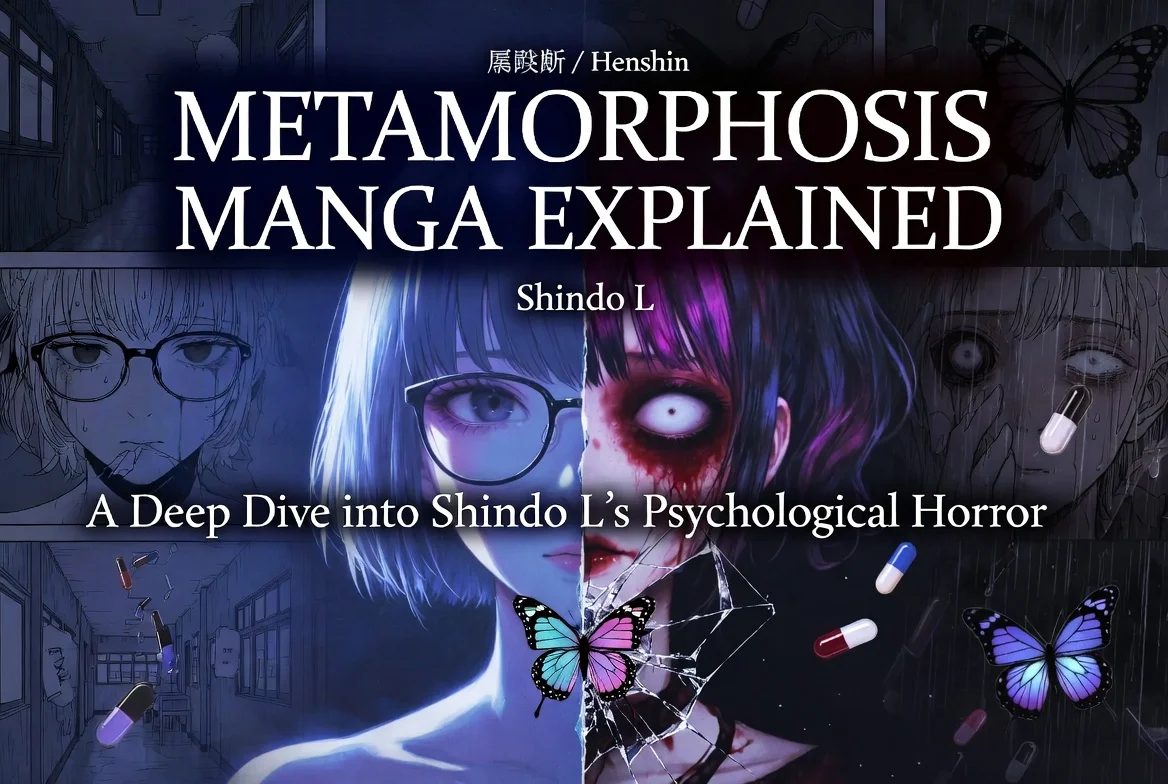
Metamorphosis Manga Explained: A Deep Dive into Shindo L’s Psychological Horror
You clicked because a friend described a manga so disturbing it still haunts them. The metamorphosis manga isn’t just graphic; it dismantles a human being slowly, leaving you hollow. Without context, the panels feel like punishment. This pillar page maps Saki Yoshida’s downfall step by step, reveals why Shindo L’s story triggers such intense reactions, and gives you the analytical framework to process it—without spiraling yourself.
What Is the Metamorphosis Manga?
The metamorphosis manga—originally titled Henshin and widely recognized by its doujinshi number 177013—is a psychological horror ero-manga created by Japanese artist Shindo L. Released in 2013, it follows a shy high school girl, Saki Yoshida, who makes a single choice to change her appearance. That decision cascades into drug addiction, exploitation, and a life on the streets. The story uses explicit imagery not for arousal but as a raw tool to depict degradation. Readers often describe it as one of the most emotionally brutal comics ever drawn.
The manga sits inside the hentai category, yet its narrative structure and emotional weight push it closer to a grim character study. Shindo L himself has stated in interviews that the work intentionally confronts topics most creators avoid: parental neglect, systemic indifference, and the fragility of self-worth. The metamorphosis manga has since generated countless reaction videos, lengthy psychological breakdowns, and even fan-made alternative endings that attempt to rescue Saki from her fate.
Key identifiers people search for:
- Henshin manga (the Japanese title)
- 177013 (the doujin ID that went viral on forums)
- Emergence (an alternative English name used by some scanlators)
The Author Behind the Disturbing Story: Shindo L
Shindo L is a Japanese mangaka known for ero-guro works that blend eroticism with grotesque horror. He gained international notoriety almost exclusively through the metamorphosis manga. Unlike many commercial manga artists, Shindo L operates largely in the doujinshi (self-published) space, which grants him freedom to explore extreme themes without mainstream editorial constraints.
In a rare interview translated by The Doujin Life in 2018, Shindo L explained he wanted to craft a story where the protagonist’s descent feels painfully inevitable because society repeatedly fails to catch those who fall. He cited real-world cases of youth addiction and the hidden homelessness behind Japan’s orderly surface as indirect inspiration. This grounding in observable social issues gives the metamorphosis manga a layer of uncomfortable realism that separates it from simple shock-value content.
His other works, like TSF Monogatari, also examine identity transformation, but none have achieved the same cult status. Shindo L is still a divisive character; some admire his unapologetic storytelling, while others contend that any message is overshadowed by the gory nature.
Plot Summary: Saki Yoshida’s Tragic Transformation
Saki Yoshida is a quiet first-year high schooler with no friends and zero self-esteem. Convinced her appearance makes her invisible, she gets a makeover before a class outing. Almost immediately, older men notice her. She attracts a manipulative senior, Hayato, who introduces her to sex and, later, to party drugs. What begins as a naive search for validation crumbles into a chain of exploitation.
The plot moves through distinct, harrowing chapters:
- The makeover and initial confidence boost – Saki feels seen for the first time.
- Coercive relationship with Hayato: He takes advantage of her need for love by pimping her.
- Drug dependency – Substances become her only escape from mounting shame.
- Estrangement from family – A single, brutal confrontation closes that door forever.
- Homelessness and survival prostitution – Saki lives on the streets, losing any remaining autonomy.
- Final degradation and death – The infamous ending strips her of even the memory of who she was.
The metamorphosis manga never offers a single moment of relief. Every chapter pushes Saki further down, mimicking the inescapable gravity of severe trauma.
Character Analysis: Saki Yoshida’s Downward Spiral
Saki isn’t a protagonist with heroic traits. She’s ordinary to the point of transparency. That ordinariness is her tragedy. Her internal monologue shows a girl desperately interpreting every harmful act as a twisted form of love. She convinces herself that abuse is attention, and attention means she exists.
The metamorphosis manga uses her voice to let readers inside the logic of self-destruction. When Hayato steals her money, she thinks he needs it. When he locks her in a room, she believes he wants to protect her. This cognitive dissonance mirrors real patterns found in trauma bonding, described by clinical psychologists as “identification with the aggressor.”
Supporting characters serve as systems of failure:
- Parents who punish instead of understanding.
- Classmates who mock rather than support.
- Adults who exploit vulnerability as a transaction.
No one extends a hand. The metamorphosis manga argues through its narrative: a society that does not nurture its quiet members will silently lose them.
Trauma and Social Alienation in the Psychology of Metamorphosis
Reading the metamorphosis manga feels like watching a psychological case study unfold. The story demonstrates how untreated adolescent depression, combined with social isolation, creates a perfect storm for predatory individuals to enter. Dr. Judith Herman’s work on complex PTSD explains that survivors of prolonged abuse often lose their sense of identity. Saki’s transformation reflects this erasure exactly.
Shindo L visualizes dissociation through panel work. As Saki’s situation worsens, her eyes become increasingly vacant, and the backgrounds blur, signaling depersonalization. The manga also illustrates the “repetition compulsion”—the unconscious drive to recreate trauma in hopes of mastering it, which instead deepens the wound.
This psychological layering keeps the metamorphosis manga in academic discussions. Several university courses on graphic medicine and manga studies include it as a text for examining how comics can portray mental deterioration without words.
Why Does the Metamorphosis Manga Haunt Readers?
The unspoken agreement that most stories adhere to—that pain leads to something worthwhile—is broken by the manga. Instead, the metamorphosis manga delivers unrelenting tragedy. Readers experience what film theorists call “negative empathy”—you feel for Saki but cannot imagine a way to help her. That helplessness festers.
Three reasons the manga lingers:
- Grounded believability: The predators aren’t cartoon villains; they exist in every city.
- No catharsis: The narrative lacks even a glimmer of redemption, defying Western storytelling expectations.
- The final page: A brief flashback to innocence juxtaposed with her brutal reality creates a devastating emotional punch.
Online forums like Reddit’s r/manga contain thousands of posts where readers describe crying, feeling physically ill, or needing days to recover. The metamorphosis manga becomes a shared traumatic experience, which paradoxically builds community.
The Infamous Original Ending and Its Emotional Impact
The original ending of the metamorphosis manga remains one of the most debated finales in doujin history. After a violent assault, Saki, pregnant and addicted, hallucinates a future where she reunites with a former classmate and raises a child. In reality, she dies from an overdose in a public restroom. The closing panels show her lifeless body, glasses askew.
Shindo L chose this ending to underline the story’s thesis: for many, there is no rescue, only a slow fade that society ignores. The decision split readers. Some call it gratuitous nihilism; others view it as a necessary jolt that forces people to see the consequences of neglect. A 2021 Japanese media ethics symposium even cited the final chapter when debating responsibilities of creators depicting vulnerable minors.
Fan-Made Alternative Endings That Went Viral
The hopelessness of the official ending sparked a phenomenon: fans creating alternative conclusions. The most famous crossover ending inserts characters from JoJo’s Bizarre Adventure. In this version, Jotaro Kujo and Josuke Higashikata stop Saki’s attackers, ensure she enters a rehabilitation program, and visit her in the hospital. The “JoJo ending” became a meme symbolizing the internet’s desire to protect fictional characters at all costs.
Other notable fan endings include:
- The “Good Dad” ending: Saki’s father realizes his mistake and brings her home.
- The “Slice of Life” reboot: Saki is depicted years later as a quiet café owner, smiling softly.
- The “Studio Ghibli” parody: Gentle watercolor panels show her living in a cozy forest cabin.
These creations highlight a collective need for narrative repair. The metamorphosis manga became a canvas where readers could finally give Saki the kindness the original denied.
How the Metamorphosis Manga Spurred Online Discussions and Memes
Beyond fan endings, the metamorphosis manga fueled broader conversations across 4chan, Reddit, and Twitter. Hashtags like #SaveSaki trended briefly in anime circles. The manga’s 177013 code turned into a shorthand for something you should “never read” yet everyone secretly discusses.
Video essayists, including popular creators on YouTube, dissected the manga’s structure, often blurring the lines between literary analysis and trigger warnings. The memes served a dual purpose: they provided comic relief from the heaviness and acted as entry points for serious dialogue about consent, drug education, and mental health.
Critics argue that meme culture trivializes Saki’s suffering. Defenders counter that humor lowers the barrier for young people to engage with difficult topics. The metamorphosis manga sits at the center of that tension.
Is Metamorphosis Appropriate for All Readers? Content Warnings and Age Ratings
No. The metamorphosis manga contains explicit sexual violence, drug use, self-harm, and psychological abuse. Japanese content rating groups classify it strictly for adults (18+). Even within adult ero-manga, it is considered extreme.
Content warnings include:
- Graphic sexual assault and coercion.
- Detailed injection drug scenes.
- Depictions of severe emotional breakdown and suicide ideation.
- Body horror elements during the final acts.
Mental health organizations like Mind (UK) advise that individuals with past trauma or active PTSD should avoid unmoderated exposure to such material without professional support. Reading with a peer debrief, journaling reactions, and scheduling lighter media afterward are harm-reduction practices that community groups often suggest. The metamorphosis manga is not a casual read.
Where to Read Metamorphosis Manga Legally and Ethically
Shindo L’s official release is published under the circle “Shindol.” You can purchase the Japanese digital version from DLsite, a major doujinshi platform that supports creators directly. English-translated physical copies surface occasionally through specialty importers, but Shindo L has not authorized an official English publication.
Free aggregation sites exist, yet using them diverts compensation from the artist. If you choose to read, purchasing the original version—even if you need a translation guide—ensures the creator receives payment for a work that clearly took an emotional toll to produce. Several scanlation teams have ceased distributing Henshin, citing the author’s wishes and the manga’s sensitive nature.
Ethical reading path: DLsite (Japanese) → support Shindo L → use a community-translated script overlay if language is a barrier.
Frequently Asked Questions
What is the story of the metamorphosis manga about?
A withdrawn high school girl, Saki Yoshida, changes her look to gain confidence, then spirals into drug addiction, sexual exploitation, and homelessness. The narrative follows her destruction with unflinching realism and no rescue.
Who created the metamorphosis manga?
Japanese doujinshi artist Shindo L wrote and illustrated the work. He self-published Henshin in 2013, and it later gained international notoriety under the file identifier 177013.
Why is the metamorphosis manga so disturbing?
The manga avoids any relief or redemption, using realistic portrayals of grooming, addiction, and societal apathy. Its graphic panels and hopeless conclusion trigger strong emotional distress, leaving readers with a sense of powerless empathy.
What are the alternative endings for metamorphosis manga?
Popular fan-made endings include the “JoJo ending,” where anime heroes save Saki, a paternal reconciliation version, and a serene café-owner future. These emerged as communal coping mechanisms to the original’s bleakness.
Is the metamorphosis manga based on a true story?
No. Shindo L has stated the manga is fictional. However, he drew inspiration from real social issues in Japan, such as youth homelessness and drug vulnerability, to ground the story in unsettling possibility.
Where can I find a detailed analysis of the metamorphosis manga’s themes?
Academic blogs, psychology-focused YouTube essays, and r/manga discussion threads offer in-depth explorations of trauma, dissociation, and social critique embedded in the manga. Always verify sources for factual accuracy.
Lasting Questions the Metamorphosis Manga Poses
The metamorphosis manga refuses to let you walk away comfortable. Saki’s destruction implicates everyone who looks away from real-world suffering. It asks direct, uncomfortable questions: How many Sakis pass you on the street? What would it take for someone to actually stop and help?
Shindo L built no exit ramp. That choice was deliberate. The only path forward is the one readers create afterward—discussing, advocating, and maybe recognizing the warning signs in people around them. If the story disturbed you, channel that discomfort into awareness. Share this guide with someone wrestling with the experience, drop a thoughtful comment on a respectful analysis thread, or support organizations that help at-risk youth. The metamorphosis manga’s legacy shouldn’t end at the last page.