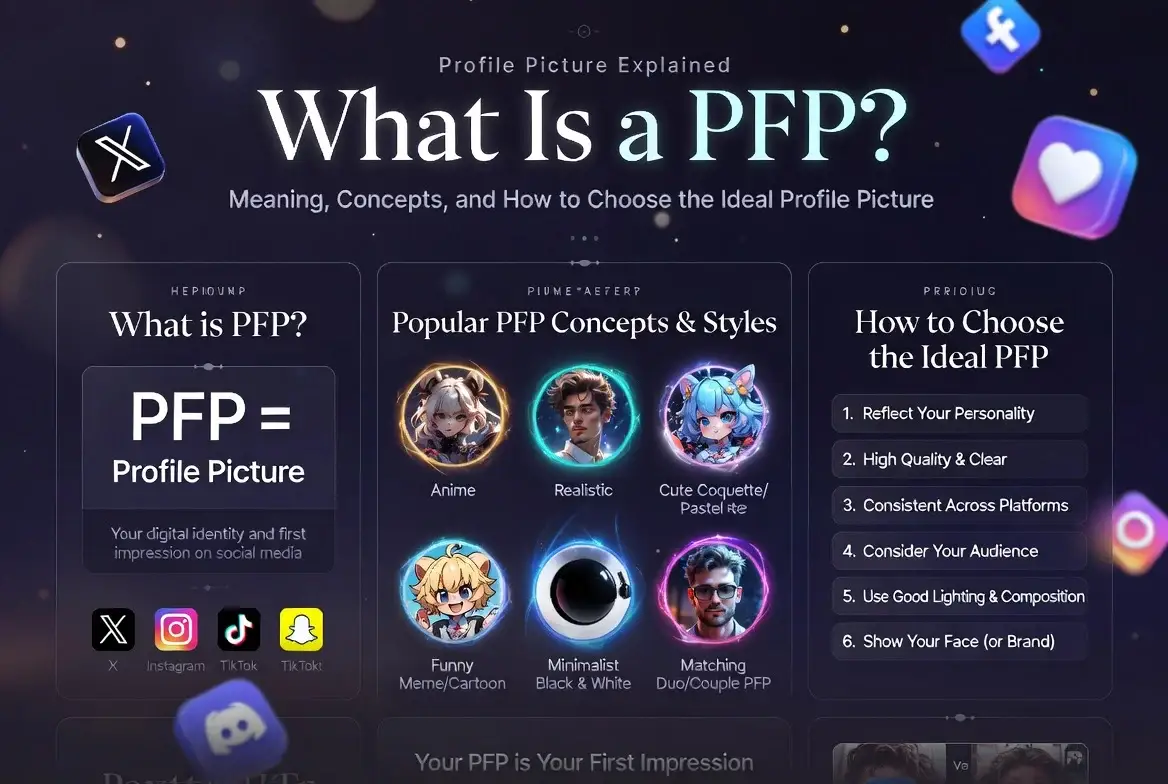
What Is a PFP? Meaning, Concepts, and How to Choose the Ideal Profile Picture
You scroll past hundreds of tiny profile photos every day without thinking twice. But the moment one catches your eye — that split second actually matters. Your profile picture is often the first real signal you send to anyone online, and most people decide whether to click, follow, or trust based on it before they read a single word you’ve written.
This guide breaks down everything: what PFP actually means, why it carries more weight than most people realize, and how to choose one that genuinely represents you — whether you’re deep into anime fandoms, building a brand, or just trying not to look like a bot.
What Does PFP Mean?
The little photo associated with your account on any social media site, messaging app, gaming network, or forum is known as PFP, or profile picture. You’ll see it next to your username on Discord, TikTok, Instagram, X (formerly Twitter), Reddit, and dozens of other places.
The term lives mostly in internet slang, especially in Gen Z spaces and gaming communities, though it’s crossed over into everyday use. You might also hear people say avatar or display picture (dp) — all three refer to the same thing.
If someone asks “what’s your PFP?” or “may I use this as a PFP?” are just inquiries about your profile picture.
Why Your Profile Picture Actually Matters
Here’s something worth knowing: psychological research out of Princeton suggests people form their first impressions of a face in under 100 milliseconds. That snap judgment — about trustworthiness, confidence, and warmth — happens every time someone scrolls past your account.
A thoughtful PFP does several quiet things at once. It builds recognition so your followers can spot your posts instantly. It sets an emotional tone before anyone reads your bio. And it signals, without words, what kind of person or creator you are.
Leaving the default avatar, or using a blurry selfie you grabbed three years ago, sends the opposite signal. It implies that no one actually uses this account.
Whether you’re using Instagram to share your life, Discord to hang out with a gaming community, or TikTok to grow an audience — the PFP is where your identity starts.
Anime PFP Ideas: The Full Breakdown
Anime profile pictures dominate Discord, X, and TikTok for a reason. They let fans represent their favorite characters and fandoms without typing a single word. The right character choice works like a visual handshake — anyone who recognizes it immediately knows something real about you.
Here are some of the most popular styles and characters people gravitate toward:
Jujutsu Kaisen PFPs — Gojo, Sukuna, Yuji, Toji, Yuta, Hakari, and Choso all have devoted followings. Gojo’s blindfolded expression projects quiet confidence; Sukuna reads as dominant and intimidating. JJK PFPs in general communicate that you’re plugged into current anime culture.
Naruto characters — Itachi remains a timeless pick for fans who appreciate complexity. Sasuke and Obito attract people drawn to brooding, layered characters. These have longevity because the fandom never really goes away.
Dragon Ball — A Goku PFP signals pure energy and determination. It’s one of the most recognizable choices you can make and works across almost every community.
Death Note — Light Yagami PFPs tend to attract fans who want to project intelligence and ambition. It’s a sharp, cerebral aesthetic.
Hunter x Hunter — Killua sits at a sweet spot between playful and lethal. Popular for both his character design and his emotional arc.
One Piece — Zoro, Luffy, and crew signal deep loyalty to a long-running fandom. These PFPs read as a badge of commitment.
Berserk — Guts PFP choices project grit, resilience, and an appreciation for darker storytelling.
Solo Leveling — The shadow monarch aesthetic has exploded as the manhwa’s popularity grew into the anime.
Bleach — Ichigo in Vasto Lorde form is a fan favorite for anyone who wants something visually striking and powerful.
Anime girl PFPs — These range from soft, cute styles with pastel palettes to fierce action poses. The aesthetic flexibility is part of their popularity.
Manga PFPs — Black-and-white panel art has a raw, artistic quality that stands out in color-heavy feeds.
When you pick an anime PFP, you’re tapping into community shorthand that builds connection before any conversation starts.
Funny PFPs That Actually Land
Humor breaks through digital noise faster than almost anything else. A genuinely funny profile picture makes your account memorable, lowers people’s guard, and invites interaction in a way that perfectly composed photos sometimes can’t.
A few categories that consistently work:
Cat PFPs — A confused or grumpy cat face has universal appeal. It actually makes any account seem softer.
Dog PFPs — Goofy, derpy dog expressions read as approachable and warm. Hard to scroll past without smiling.
Snoopy PFP — Nostalgic and wholesome. works with people of all ages without feeling pressured.
Drake PFP — Meme culture has turned certain Drake expressions into cultural shorthand. Using one signals that you’re in on the joke.
Batman PFP — The dark knight used ironically, especially when paired with absurd captions, creates a very specific and entertaining contrast.
Chief Keef PFP — A staple in underground hip-hop spaces and ironic meme circles. Projects an unfiltered, raw energy.
Femboy PFP — Playful and deliberately boundary-bending. Generates curiosity and conversation.
One thing to keep in mind: a funny PFP works best when the humor matches the tone of your actual content. If the joke doesn’t connect to what your account is about, it just reads as random.
Cool and Bold PFPs for a Strong Presence
Some profiles call for an image that radiates confidence without trying too hard. A cool PFP typically relies on clean lines, strong contrast, and visuals that feel effortlessly self-assured — not loud, just solid.
A few examples that consistently trend in this direction:
Silver Surfer PFP — Cosmic, minimalist, and philosophically unbothered. A niche but memorable choice.
Sonic PFP — Retro energy that never fully goes out of style. Works especially well in gaming spaces.
Spider-Man PFPs — Miles Morales, Spider-Man Noir, and classic Spidey all offer different flavors of heroism. Grounded but aspirational.
Black PFP — A solid black square signals minimalism, mystery, or sometimes a form of quiet protest. It’s one of the few cases where doing less communicates more.
The throughline in cool PFPs isn’t aggression — it’s composure. The image suggests you’re not competing for attention; you just have it.
Matching PFPs: Friendship and Partnership on Display
Matching profile pictures are exactly what they sound like: two (or more) people using coordinated images — split halves of one photo, complementary characters, or a shared theme. This trend took off on TikTok, Discord, and Instagram as a way to make relationships publicly visible without needing a caption.
Cute matching PFP sets often feature soft anime duos, Sanrio characters, cuddly animals, or pastel illustrations. Cinnamoroll and Kuromi pairings are especially popular for best-friend combos. Chibi-style anime couples are a go-to for romantic pairs.
There’s something about the act of choosing and syncing those images that strengthens real bonds. It’s a small creative decision made together, and the result is visible every time either person shows up in a comment section or chat.
Aesthetic and Coquette PFPs: Mood Over Subject
Aesthetic profile pictures are less about who or what is pictured and more about how the image makes you feel. Soft filters, warm evening light, vintage grain, intentional color palettes — these elements work together to create a specific emotional atmosphere.
The coquette PFP trend has built a dedicated following within this category. Coquette aesthetics borrow from ballet, lace, bows, and romantic femininity. Pink is the dominant color — blush tones, rose petals, cotton candy skies. Kuromi and Cinnamoroll fit naturally here, blending Sanrio’s characteristic charm with a slightly dreamy or rebellious edge.
Cute anime girl PFPs with sparkles, soft hair, and pastel backgrounds communicate careful attention to detail. They attract audiences who are drawn to beauty-focused content.
Choosing an aesthetic PFP is implicitly committing to a visual identity. Everything in the image — the color temperature, the crop, the subject — contributes to the overall feeling. Inconsistency between your PFP and the rest of your profile can feel jarring, so it’s worth thinking about the whole picture.
Platform-Specific PFP Tips
TikTok — Match your PFP to your niche. Comedy creators lean into funny, expressive images; beauty and lifestyle creators use polished, aesthetic shots. The thumbnail is small, so bold subjects and high contrast matter.
Discord: Animated GIFs are available to Nitro users. Even static PFPs benefit from strong contrast at small sizes since Discord displays them tiny in server lists.
Instagram — Displays in a circle. Keep important details centered and away from the edges or they’ll be cropped out.
Reddit — Very small display. Simple, high-contrast images work far better than anything detailed or intricate.
School platforms (Google Classroom, Edmodo, etc.) — Keep it clean, clear, and recognizable. A straightforward headshot or simple illustration reads as professional and makes it easy for teachers and classmates to identify you quickly.
LinkedIn — This is one place where tone alignment genuinely matters. Meme-based or ironic PFPs that work perfectly on Discord will undercut your credibility here. Match the platform’s professional register.
PFP Size and Dimension Guide
| Platform | Minimum Size | Recommended Size | Display Shape | Notes |
| 110 × 110 px | 320 × 320 px | Circle | Keep focal point centered | |
| TikTok | 20 × 20 px | 200 × 200 px | Circle | Bold colors essential at small size |
| Discord | 128 × 128 px | 512 × 512 px | Circle | Nitro users can upload animated GIFs |
| X (Twitter) | 200 × 200 px | 400 × 400 px | Circle in feeds | Square display on full profile page |
| YouTube | 98 × 98 px | 800 × 800 px | Circle | Visible in comments and live chat |
| 256 × 256 px | 256 × 256 px | Circle | Very small; simplicity is key |
Export as PNG for sharpness or JPEG for smaller file size. Always test your final image at 50 × 50 pixels — that’s roughly the size it appears in most comment sections and chat threads.
How to Create a Good PFP Without Design Experience
You don’t need to be a graphic designer. A few straightforward approaches:
Free tools — Canva, Adobe Express, and Picsart all offer templates sized for popular platforms. They’re beginner-friendly and free to start.
Crop strategically — Tight crops almost always look stronger than wide shots at thumbnail size. Get close to the subject.
Test at small size — Before committing, zoom out or shrink the preview to see how it reads when tiny. If the focal point disappears, simplify.
Check contrast — High contrast between subject and background makes images pop at small sizes. Dark subject on a light background (or vice versa) is usually more readable than similar tones.
Instagram PFP downloaders — If you want to save your own previously uploaded photo in full resolution, free web tools exist that let you pull it by username. Respect copyright and privacy; only use these tools for your own content or with permission.
Common PFP Mistakes Worth Avoiding
Uploading a blurry or low-resolution image — It reads as careless. Always start with the highest resolution you have.
Leaving the default avatar — Default profiles look abandoned, temporary, or automated. Even a simple, solid-color image with your initials is meaningfully better.
Too much detail at small sizes — Intricate compositions collapse into visual noise at thumbnail scale. Simpler wins.
Ignoring the circular crop — Round frames cut corners. If key details sit at the edges, they’ll disappear on most platforms.
Wrong tone for the platform — A great meme PFP on Discord can quietly damage credibility on LinkedIn or Edmodo. Know where you’re posting.
Forgetting seasonal or time-sensitive PFPs — A holiday-themed PFP that stays up two months past the holiday reads as inattentive. Swap it out when the moment passes.
Copying someone else’s PFP exactly — Inspiration is fine. Cloning another person’s exact image creates confusion and erodes your own distinctiveness.
Frequently Asked Questions
What does PFP mean?
PFP means profile picture — the image associated with your account on social platforms, messaging apps, and gaming networks.
How often should I update my PFP?
Whenever your identity, mood, or focus shifts noticeably. A seasonal refresh every few months keeps things current without confusing your regular followers.
Can I legally use any image as my PFP?
Not necessarily. Using someone else’s photography or artwork without permission carries copyright risk. Safest options are original content, Creative Commons-licensed images, or fan art that explicitly permits personal use.
What size works across most platforms?
A 500 × 500 px square in 1:1 ratio works as a solid master file you can resize down for any specific platform.
Why do people use matching PFPs?
They’re a way to publicly signal a close friendship, romantic relationship, or shared fandom. Choosing and syncing the images together is itself a small bonding experience.
In a busy stream, how can I make my PFP stand out?
Strong contrast, a clean focal point, and colors that pop at thumbnail size. Test at 50 × 50 pixels — if the subject is still recognizable, you’re in good shape.
Final Thought
Your profile picture isn’t decoration. It’s the first impression you make on every person who encounters your account, and it keeps making that impression every time you comment, post, or appear in someone’s notifications.
Whether you’re drawn to an anime character that signals your fandom, a soft aesthetic that communicates care, a funny image that makes people smile, or a clean minimalist look that just feels like you — the best PFP is one you actually chose deliberately. Pick something intentional, test it at small sizes, and pay attention to how people respond. Your entire internet presence can be subtly altered with a single well-considered upload.
Sources: Princeton University research on rapid social judgment; University of York neuroscience research on facial attention.